
This is one of my reasons to squat. I want to keep doing this for a long time.
Good morning, Sensemakers!
A friend sent me a video of a guy doing something very cool, with exactly that question. I have been asked it hundreds of times, and my answer has stayed the same for years. I think it is important to share it with you, because it is a good example of how common sense applies to training.
- Why we train
- Why the same exercise can serve many goals
- How to tell whether someone else's program makes sense for you
But first…
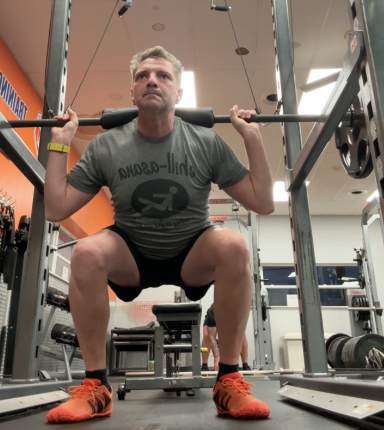
My leg workout is built for two goals. I want to keep my muscle, flexibility and balance as part of my longevity plan. And I want to stay on the board when I wing foil, which demands all three, with very specific needs. Same squat, my reasons.
Imagine three people doing squats next to each other. One wants bigger legs. One wants to jump higher. One wants to keep getting out of a chair without help twenty years from now.
From the outside, it is the same exercise. So my answer to my friend always starts with a question: which goal is it for?
1. Why does this matter?
Three goals, one squat
Bodybuilding: developing muscle size and the appearance of the body.
Athletic performance: becoming better at the demands of a particular sport.
Longevity: maintaining the physical capacity to keep living the life you want as you get older.
All three are valid. I like looking good. I like being capable. And I would quite like to keep both for a while. 🙂
But when we choose a program, it helps to know which goal gets the deciding vote.
Take the squat. The name of the exercise tells us surprisingly little.
How much weight are we using? How many repetitions and sets? How quickly are we trying to move? How much rest between sets? Between training days?
Those details change the training stimulus, the fatigue and how the exercise fits into the rest of our lives.
The squat is the tool. The program tells us what we are trying to build with it.
2. Where am I (now)?
The Good
For me, "the good" is training that fits your goal, your current ability and the life around your workouts.
For bodybuilding, gaining muscle may be the result you are chasing. In a sport, the question is whether the training helps you perform when it matters. If your priority is longevity, I would ask what the training helps you keep doing. Carry your luggage. Climb stairs. Get up from the floor.
Different scoreboards. You cannot judge every program by the same one.
The Bad
"The bad" is what happens when we borrow someone else's program without borrowing their reason for doing it.
We see a bodybuilder with extraordinary legs and copy their squat routine.
The missing question is: What was this designed to achieve, and is that what I want?
A good answer to someone else's question can still be a poor answer to yours.
The Ugly
"The ugly" is when we lose sight of the goal altogether. More weight, more exhaustion, more soreness becomes the goal.
I like a challenge. You probably worked that out from last week's issue about discomfort. But difficulty needs a job. Otherwise, we can get very good at making ourselves tired.
3. What can I do?
We can borrow the tools
Now, before this becomes too neat, the three goals overlap.
A program aimed at longevity can absolutely borrow methods from bodybuilding.
Resistance training can improve both strength and muscle size in older adults. The exercises might be identical. What changes is how much we need, what else deserves attention and what we are willing to spend to get there.
For someone training for longevity, muscle is part of a wider picture that also includes strength, endurance, balance and the ability to move well.
Borrow the method. Keep your own purpose.
One useful step this week
Before your next workout, answer three questions:
- What is my main training goal right now?
- What is this program designed to improve?
- What would show me that it is working for me?
Because before asking, "Is this a good exercise?" I would ask:
Hit reply and tell me which goal gets the deciding vote in your training at the moment. I read every reply.
And if you know someone who copied a program that was never built for them, forward this to them.
Sources
- American College of Sports Medicine. ACSM Unveils Landmark 2026 Resistance Training Guidelines (March 17, 2026): how training choices differ according to goals such as strength, muscle growth and power.
- World Health Organization. Physical activity and sedentary behaviour: a brief to support older people: maintaining physical function through strength, aerobic activity and balance.
- Borde R, Hortobágyi T, Granacher U. Dose response relationships of resistance training in healthy old adults: a systematic review and meta analysis. Sports Med, 2015.
Making Sense shares educational information, not individual medical advice.