Good morning, Sensemakers!
There is no shortage of advice about what to measure, optimize, supplement and improve. Today I want to bring your attention to something that we most likely don’t notice.
That is exactly why I keep coming back to the same three questions:
Where am I now?
What can I actually do about it?
🤲 Why touch may matter more to our nervous system than we think
🔍 How to notice whether it has quietly disappeared from your own life
❤️ And why the answer is probably not another protocol
The photograph above is from Sauble Beach, on the fourth of July.
We have a small tradition with friends in Canada. For years we stood in a circle at the beach and took a photo of our bare feet. It was a silly reminder to chill and stay down to earth, at least for me. This year my friends threw another of those parties they are so good at, and the girls put their hands in the middle for the photo instead.
Almost touching.
I thought it was a good metaphor for today’s newsletter. And it is cool to know there is a person I know, and have touched, behind every hand in that photo.
A few days ago I was in Rome, finally walking through the Vatican Museums and the Sistine Chapel.
Like everyone else, I had seen Michelangelo’s Creation of Adam hundreds of times before.
Seeing it there is different.
And, strangely, I didn’t take a photo of it.
I wasn’t trying to make a point about being present. I simply didn’t feel like becoming one more person holding up a phone to photograph an image that already exists in millions of better photographs.
What I did photograph was this staircase on the way out.
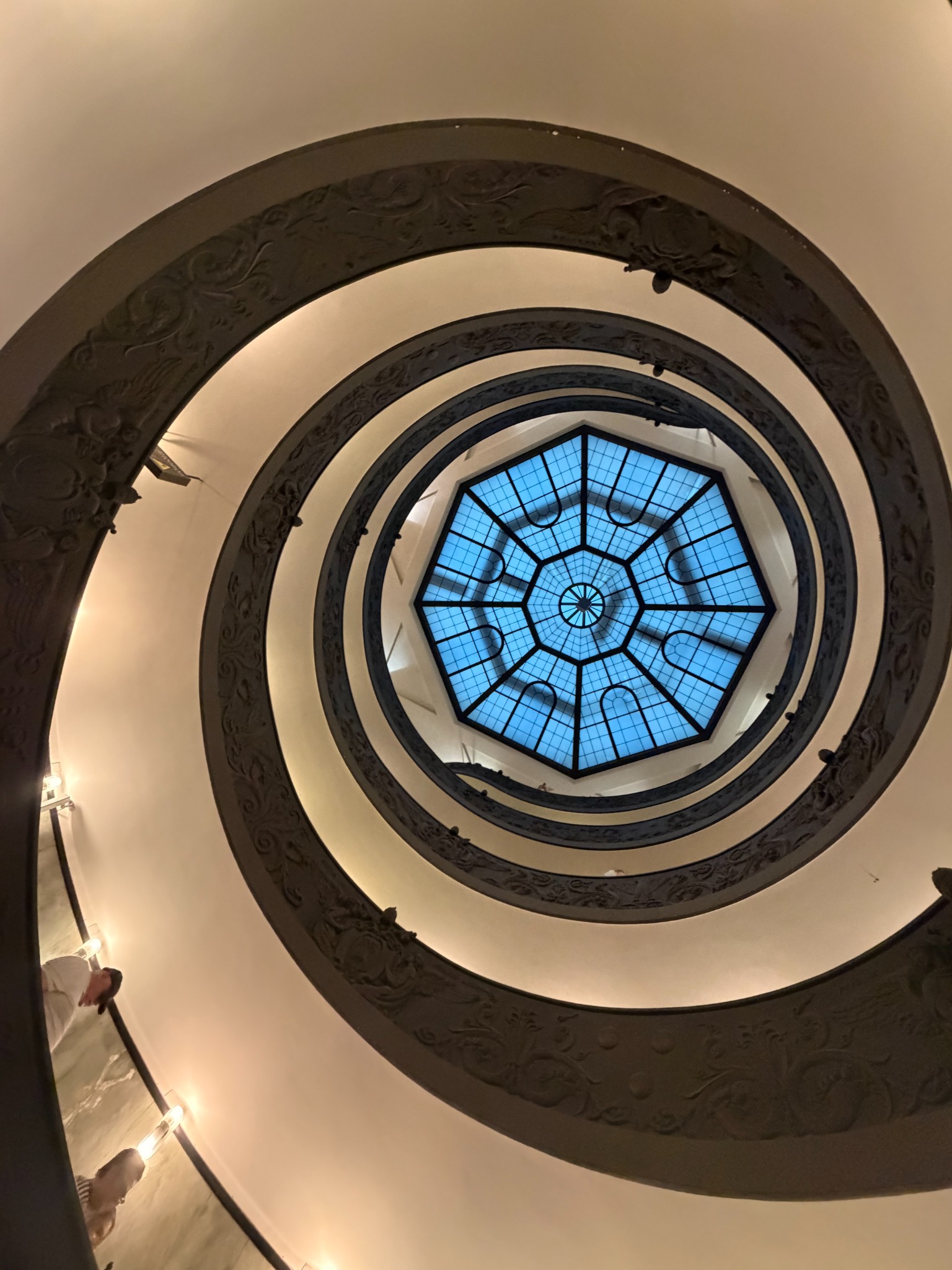
Spirals have always fascinated me.
And when you stand near the bottom of this one, you start noticing something else.
People move around you in both directions. Up and down. Passing one another constantly.
Most barely notice the person going the other way.
No conflict. No drama. Just people sharing the same space, moving close to each other, and continuing on.
And I found myself wondering:
We pass.
We scroll.
We message.
We sit next to people.
We work with them.
We live among them.
And still, somehow, we may be touching each other less.
That thought took me back to the image I hadn’t photographed.
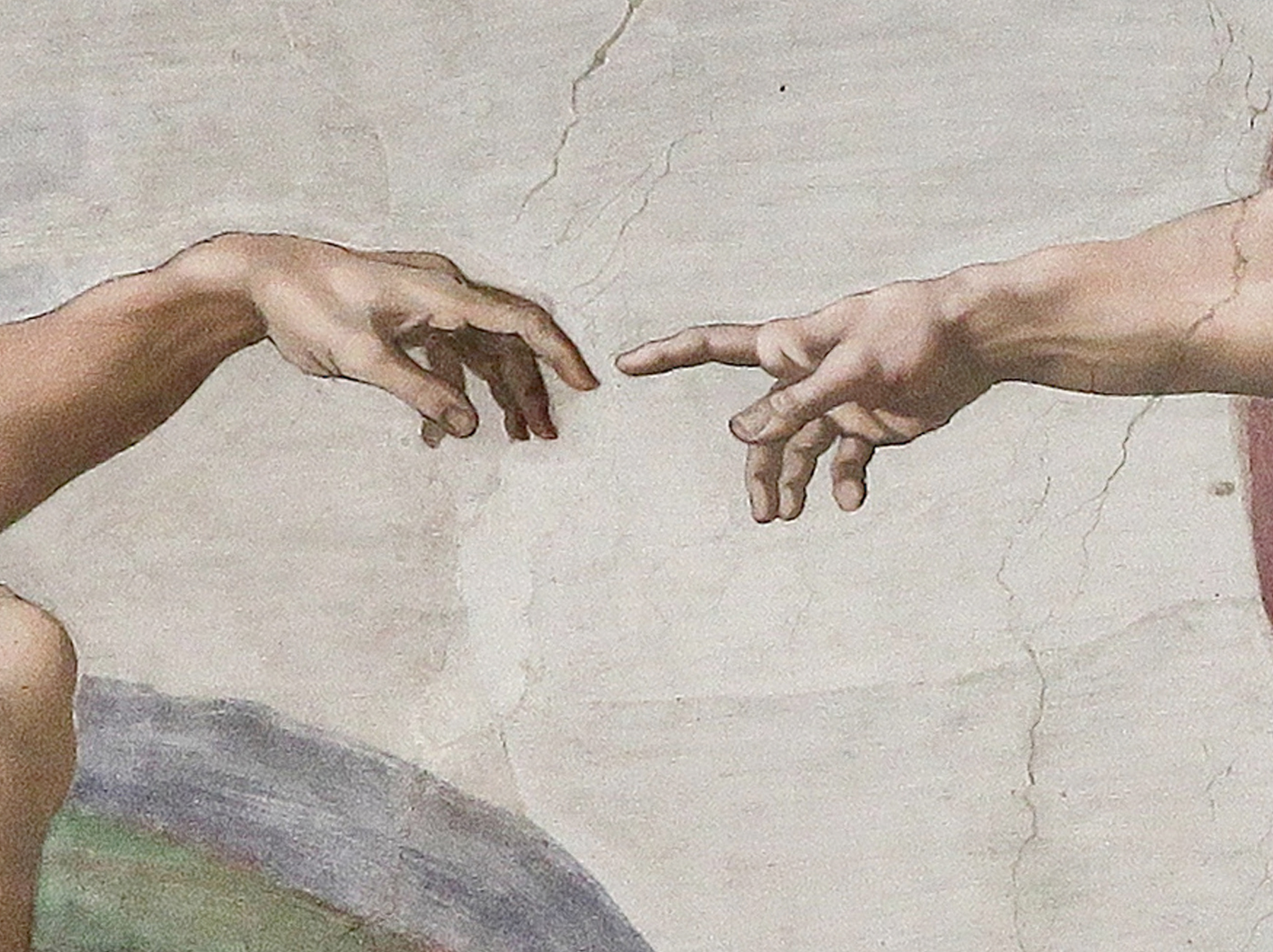
Two hands.
Almost touching.
That tiny gap between Adam’s finger and God’s is probably one of the most famous few centimetres in art.
And suddenly the question felt much less philosophical.
Not digitally.
Not socially.
Physically.
Because while we have become increasingly interested in everything that regulates our bodies, glucose, HRV, sleep, breathing, supplements, exercise, we may be overlooking one signal humans have been exchanging for a very long time.
Another human being.
And that sent me looking at the science.
1. Why does this matter?
Touch is easy to dismiss as something emotional.
Nice. Comforting. But not essential.
The evidence suggests it may deserve more attention than that.
A large systematic review and meta-analysis published in Nature Human Behaviour brought together more than 200 studies and almost 13,000 participants.
Across adults, touch interventions were associated with improvements in several outcomes, particularly pain, anxiety and depressive symptoms.
In newborns, touch interventions were also associated with changes in outcomes including cortisol and weight gain.
That does not mean a hug is medicine.
The studies used very different forms of touch. Massage, holding, skin-to-skin contact and other therapeutic interventions. Different people. Different settings. Different outcomes.
And because you obviously know whether someone is touching you, this kind of research is difficult to blind properly.
So I would be careful with headlines claiming that touch “switches off” the brain’s threat centres or that a certain number of hugs will transform your health.
The signal is interesting enough without the hype:
Humans appear to respond biologically to appropriate, wanted physical contact.
I wrote recently in Who Will Pick Up When You Call that you cannot exercise your way out of loneliness.
Touch may be another part of the same story.
Social connection is not just the number of people in your phone.
Sometimes it is physical too.
2. Where am I now?
No lab required.
Think about yesterday.
Not your best day.
Not your last holiday.
Yesterday.
A hug.
Holding someone’s hand.
A hand on your shoulder.
Sitting against someone you love.
Putting your arm around your child.
Someone putting theirs around you.
There is no score.
I don’t think we need one.
The point is simply to notice.
We can be surrounded by people and still have remarkably little physical contact.
We can talk to dozens of humans in a day without being physically close to any of them.
Digital connection has given us extraordinary access to one another.
But a message, a Zoom call and a ❤️ reaction are not necessarily the same experience for the body as another person being physically present.
3. What can I do?
This is where health advice often becomes silly.
Someone finds an association.
Someone else turns it into a protocol.
Soon we are told exactly how many hugs we need and how many seconds each one should last.
I don’t think that is where this evidence takes us.
My useful step is much smaller:
If you have a partner, children, parents or close friends who are comfortable with physical affection, don’t automatically skip those small moments.
Hug them.
Hold the hand.
Sit closer.
Put an arm around somebody.
Not because you have completed your daily touch prescription.
Because this may simply be one of the ways human beings regulate each other.
And, importantly:
Wanted touch is not the same thing as touch.
For some people physical contact is deeply comforting.
For others, because of personality, culture, experience or trauma, it may be uncomfortable or threatening.
Consent is not a footnote here.
It is part of what makes the signal safe.
When I started Making Sense, the idea was never to collect more health information.
It was to ask a more useful question:
That was the idea behind What Kind of 80-Year-Old Are You Preparing to Become?.
Sometimes the answer is a laboratory result.
Sometimes it is exercise.
Sometimes it is sleep.
And occasionally, the thing deserving attention may be so ordinary that we stopped noticing it.
I keep returning to Michelangelo’s two hands.
Not because I think the painting is secretly about neuroscience.
It isn’t.
I just like the reminder.
Two people can be very close and still not touch.
We seem to be getting very good at that.
Maybe it is worth noticing.
Was this useful?
Did it help you make a little more sense of the noise and lead you to action?
Reply and tell me. I read every reply.
If you know someone who would find this useful, please forward it to them.
One focused idea every Wednesday.
Health, longevity and human performance without the noise. Subscribe to receive Making Sense by email.
- A systematic review and multivariate meta-analysis of the physical and mental health benefits of touch interventions, Nature Human Behaviour, 2024.
- “In over 30 years, I’ve never seen something this powerful”: Experts have finally learned how the right human touch can transform your health, BBC Science Focus.
One subject at a time. Less noise. More clarity. In under five minutes.