Good morning, Sensemakers!
I think having common sense is a bit like having a sense of humor. Even if you are not born with it, you can develop it. Especially if you surround yourself with people who show common sense, or who have a good sense of humor.
So today's issue is a kind of experiment. If you like it, it might be the first of many.
The experiment goes like this. We pick a topic that is not necessarily about health and wellbeing, and we apply the Making Sense frame to it, in an attempt to… well, make sense of it.
And what better way to start than with a question probably every one of us has asked at some point: where the heck is everybody?
- How big the universe really is
- Why such a big universe looks so quiet
- What a sky full of silence can teach us about evidence
But first…

A couple of nights ago I walked through the dark and quiet neighborhood of Loveland.
There is a point where my path comes close to the nearby golf course. That big open area with no artificial lights makes the sky darker, and suddenly you can see so many more stars.
Elzie and I always stop there for a moment and stare up at the sky. Almost always I can spot a plane, and sometimes even a satellite, crossing above us.
I am sure every one of us has had that moment of awe when looking up. The deep realization of how incomprehensibly huge the world is, and how small we and our planet are.
Are we alone in this big universe? Is it possible that we are the only ones?
It is a question that fascinates me. And I thought it would be a great one to approach with the Making Sense tools.
1. Why does this matter?
A question over lunch
In the summer of 1950, the physicist Enrico Fermi was having lunch at Los Alamos with three colleagues. At some point Fermi asked a simple question. The people who were there remember it slightly differently, but the version that stuck is: "Where is everybody?"
His reasoning went something like this. There are a lot of stars, and the galaxy has had billions of years. If even a small share of them produced a civilization, some should have had time to spread out, or at least contact us to say hello.
So where are they?
That is the Fermi Paradox.
How big is "a lot"?
Our galaxy, the Milky Way, is about 100,000 light years across. It holds somewhere between 100 and 400 billion stars.
And it is one of about 2 trillion galaxies in the observable universe. The observable universe is about 93 billion light years across.
Making Sense of… our cosmic "hello"
Numbers like these stop meaning anything after a while. So let's bring in some simple drawings to help us make sense of them.
We have been broadcasting radio and TV for roughly a century. Those signals travel at the speed of light, so the very oldest have reached about 100 light years from Earth. That makes a bubble around us roughly 200 light years across.
Sounds big. Now let's zoom out.
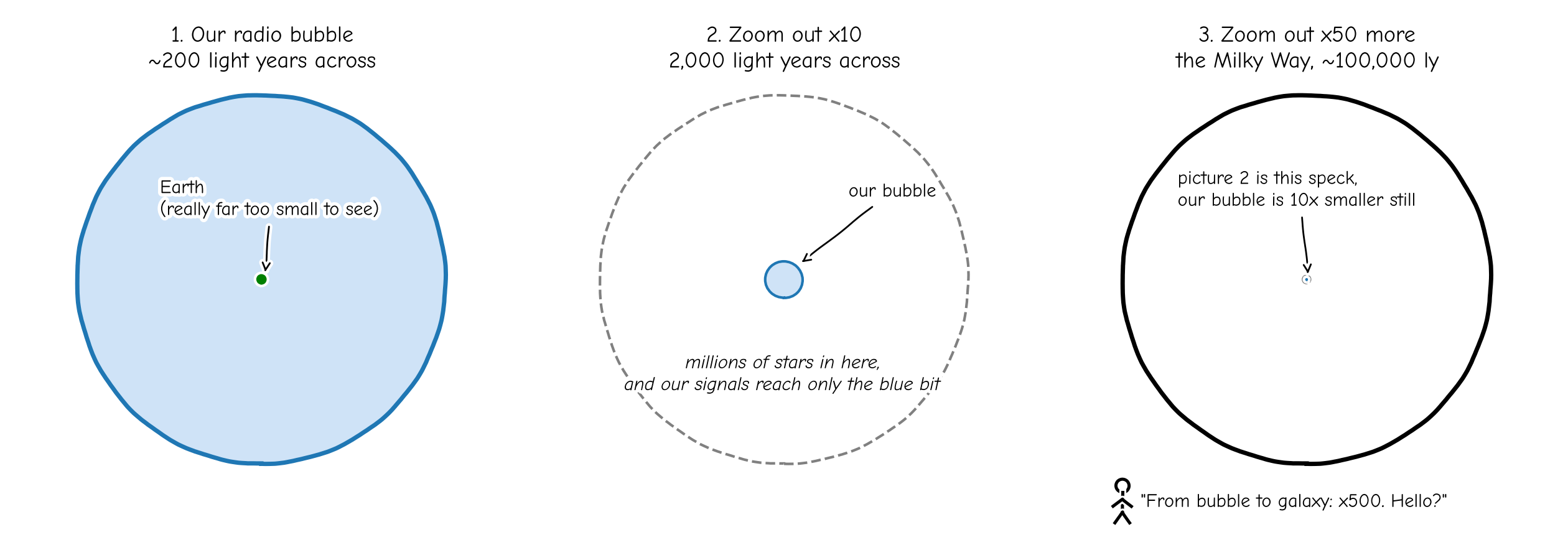
Zoom out ten times, and our bubble is a small circle in a patch of space full of stars.
Zoom out fifty times more, and you see the whole Milky Way. Our bubble is now a speck you can barely find. You could line up 500 of them side by side before you crossed the galaxy.
And even that speck is generous. Ordinary leakage from our planet could probably only be picked up from a few dozen light years away.
So before we ask "Why has nobody called?", it is fair to ask: "Would anybody have heard us?"
2. Where am I (now)?
Organizing our ignorance
In 1961 the astronomer Frank Drake wrote down an equation to estimate how many civilizations in our galaxy we might detect. It multiplies seven things: how fast stars form, how many have planets, how many planets could support life, how often life appears, how often it becomes intelligent, how often it becomes detectable, and how long it stays detectable.
The first few we now know reasonably well. Thanks to thousands of exoplanet discoveries, it looks like most stars have planets.
The rest? Mostly guesses.
The astronomer Jill Tarter called the Drake equation "a wonderful way to organize our ignorance". I like that a lot.
The popular explanations
Over the years, people have suggested many answers. A few of the best known:
- The Great Filter. Somewhere between dead chemistry and a civilization that spreads across space, there is a step that almost nobody passes. The economist Robin Hanson asked the uncomfortable question: is that step behind us, or ahead of us?
- Rare Earth. Planets are common, but planets with everything needed for complex life may be very rare.
- The zoo hypothesis. They are out there, but they deliberately leave us alone. Like animals in a nature reserve.
To be clear, these are speculation. Interesting, sometimes useful, but none of them has evidence behind it yet.
The quiet answer
In 2018, Anders Sandberg, Eric Drexler and Toby Ord at Oxford tried something simple. Instead of plugging one confident guess into each part of the Drake equation, they used the full range of what we honestly do not know.
The result changed the picture. When the uncertainty is taken seriously, an empty galaxy stops looking strange. In their main model, the chance that we are alone in the Milky Way came out at around one in two.
Their own words are careful: this does not mean we are alone. It means being alone would not be surprising.
The paradox, they argue, came less from the sky and more from our overconfidence.
3. What can I do?
Bring this home
You might be wondering what aliens have to do with a newsletter about health.
Quite a lot, actually.
Absence of evidence is not evidence of absence. The silence does not prove nobody is out there. But it is also not proof that someone is.
We meet the same trap in health all the time. "There is no study showing it is harmful" is not the same as "it is safe". And one exciting result with ten confident assumptions behind it is not the same as knowing.
Notice what the Oxford team did. They did not find new data. They simply stopped pretending to be more certain than they were. And the "mystery" became much less mysterious.
That is a habit worth borrowing.
One useful step this week
Next time you see a headline like "Study shows X adds years to your life", stop for 30 seconds and ask three questions:
- What was actually measured? Years of life, or a blood marker that might be linked to it?
- In whom? Mice, 20 volunteers, or thousands of people followed for years?
- What is a guess dressed up as a number? "Adds 5 years" often comes from a model, not from people who actually lived longer.
Then give the claim an honest score: know, likely, or guess. If it ends up a guess, that is fine. Saying "I don't know yet" is often the most accurate answer we have.
Hit reply and tell me: do you think we are alone? And what made you think so? I read every reply.
And if you know someone who loves looking at the night sky, forward this to them.
Sources
- Jones, E. M. "Where is everybody?" An account of Fermi's question. Los Alamos National Laboratory, 1985: the 1950 lunch with Konopinski, Teller and York.
- NASA. Our Milky Way Galaxy: How Big is Space?: about 100,000 light years across, 100 to 400 billion stars, one of about 2 trillion galaxies.
- NASA. How Big is Space? We Asked a NASA Expert (2025): the observable universe is about 92 to 93 billion light years across.
- SETI Institute. The Drake Equation: the 1961 equation, its factors, and our less than a century of broadcasting.
- Hanson, R. The Great Filter: Are We Almost Past It? (1998), which also discusses the zoo hypothesis (Ball, 1973).
- Sandberg, A., Drexler, E., Ord, T. Dissolving the Fermi Paradox (2018): uncertainty in the Drake equation, the Jill Tarter quote, and detection range of Earth's leakage (about 18 parsecs, roughly 60 light years).
Making Sense shares educational information, not individual medical or scientific advice.